Hello, and welcome back to Queries (this is the seventh edition!). If you’re new here, I’m Carl Rosen, New York’s copy chief, and for the next five weeks I’ll be talking with features editor Katie Ryder about all things words, grammar, and style. This week, we discuss neologisms, the style of styles, and Chekhov’s “story of a miserable official who ate gooseberries.”
Katie Ryder: What are you most interested in right now?
Carl Rosen: Something I recently read about the Epstein files struck me for its description of the “lexical touch-off.” That's when an unusual or unexpected word or phrase surfaces and everybody starts repeating it. When I see this happening at the magazine, I wonder, Who came up with that expression? Did someone release a memo? (I feel a similar befuddlement when archaic terms rise from the dead, Vlad Tepes style, often with a new meaning attached.) Sudden arrivals, especially ubiquitous ones, raise my guard as a copy editor because I’m ever wary of what I read until I can figure out what writers are up to. I love new words, but novelty for its own sake doesn’t enhance communication.
It becomes dreary.
It can be camouflage for bad writing. Fad phrases from the crevices of culture (“countdown bidding” for Hello Kitty journals on TikTok, anyone?) are fun, though, and proper styling by our troops in the copy department can help writers keep them fresh. In early days of an expression, we have the opportunity to set the ground rules for usage. So if a neologism doesn’t appear in our favored dictionary (which incidentally underwent a traumatic update in November that rendered it more Sophomoric than Collegiate), our copy desk can supplement the official record after spirited internal debate about spelling and inflection. (Questions may include “Is this new word a PR scam? A code for discrimination?” and “Should we allow it to be verbified?”) Then there are house-style recommendations for applying or eschewing terms depending on form and context; for instance, our rules for display text (headlines and deks) differ online and in print, as do our rules for what is acceptable in the main body of a story. All of this needs to be taken into account as we consider usage of a new term.
I come across the same issues of relevance and texture regarding new words in three-sentence blurbs and 6,500-word features — it always boils down to “Does the puzzle piece fit?” Sometimes a new term can be adapted; it can be reworked to great effect and improve stories in unusual ways. I’m pleased to note, for example, that after an initial surge, restraint has marked our editors’ approach to the bound morpheme -maxx. The suffix originated as part of looksmaxxing on creepy internet forums and metastasized in nefarious ways (jestermaxxing?!) before joining the popular scrum that is English. (Unrelated but well known to weekend warriors at the mall: @maxxinista.) I was at least familiar with the double-x spelling because we employ it for anti-vaxx and anti-vaxxer, which have similar origins in a figurative right-wing vermiform appendix (though we got saddled with single-x doxing thanks to Merriam-Webster’s). A few months ago, everybody maxed out (single x in all reference books) on its usage online, and by the time it began its migration to print, -maxx seemed in danger of flaming out. We did find a way to present it sparingly for greater effect, and it’s evolving into a lively intensifier — writers can absolutely, positively never, ever, get enough of those. But new is for now, not for the long run. That’s why I believe -maxx will eventually join shizzle in the Scrapyard of Surpassable Superlatives.
Can you talk a little bit about the differences in how we handle this in print and online?
It is by necessity — it’s a struggle in close quarters, a literal fight for space, with the smallest syntactical unit producing an outsize effect on the integrity of an issue. The -maxx issue is relevant: As copy chief, I’m charged with matching supply of terms with demand, a duty intensified by the heat of a print-closing day.
Our recent “Salary Issue,” for instance, when it first came to me, was to have three -maxx references, two rubbing shoulders on a single page — raising the question of maximal limitations. I wasn’t exactly asked to “bring out the Holy Hand Grenade,” but I got no pushback on my request for proportionate usage of the bound morpheme. (I had prepared the field in January by arguing successfully for reducing a double -maxxing in “Approval Matrix” to a lone, plangent “austerity-maxxing,” which struck a chord on the website.) So one -maxx (as colormaxxed) was engaged for maximum (tasteful) effect — okay, tastemaxxing — in the display of the always delightful “Design Hunting,” which thankfully declined to use the declensional commercial term colorways for the umpteenth time (have I mentioned “ick neologisms”?). The two -maxxings elsewhere were reracked for future deployment.
These small decisions assist our larger project — a massive web presence, like thought thinking thought, in tandem with the IRL invention of a tactile, tensile New York Magazine on a two-week schedule, a human invention prepared by human beings for human readers and populated with probing features (to wit, a game that mirrors the mind) flanked by opinion and politics (Intel), service and style (the Strategist), and discernment and review (the Culture Pages), guarded at the rear by puzzle and “Approval Matrix.” (Are there good golems? If so, this is one, and are you surprised that I think about this kind of thing every day?) Ensuring that even the smallest parts of speech are in fighting trim, under time and space constraints that go back to Gutenberg, is the Copy Department’s contribution to the making of “a damned nice thing — the nearest run thing you ever saw in your life” (apologies to Arthur Wellesley). Then it’s on to the next issue — it’s always one battle after another …
A lot of people think of copy editors as rule followers, but it’s an active, responsive process.
Yes, we are the rule followers, but we know which rules have been amended; which are more myth than precedent; how changes in style have played out, for better and worse; what presumptions are just standard English that a new generation is coming to grips with; what it means to be the editor’s proxy, which requires on-the-spot recognition of their intentions (and the writer’s, of course); the time and place for common parlance and when to subrogate it — stuff like that.
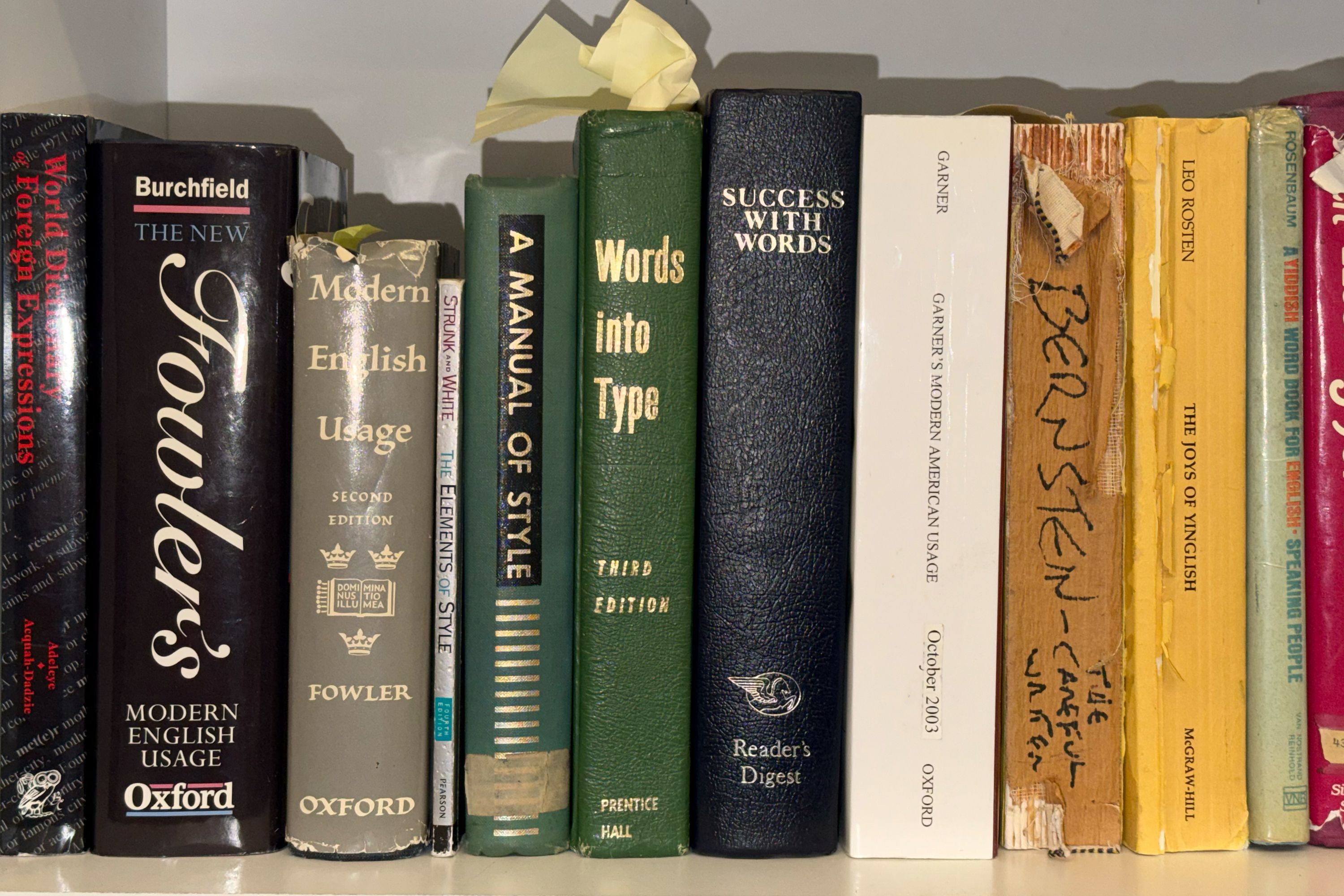
And the rules are slippery things. It’s more like we the copy editors have seen a large enough selection of sentences both using and abusing standard terms that our natural skills are supplemented by a magazine (to extend the military metaphor) of solutions. “Standard English” is supposed to be the golden rule. Classic sources like Fowler’s Modern English Usage say to avoid “elegant” variation, by which “inelegance” is wryly meant, but strict adherence to that “rule” leaves you with repetition. Therefore, you may recoil from the dazzling clarity of a standard term (I’m tired of my diamonds!), and, of course, engagement requires novelty. But what happens when the writer, underestimating the reader, opts for the equivalent of shizzle? That’s when standards get pounded flat.
And there are always new issues to tackle. For example, I’ve started to see the word style attached to words that describe a style: minimalist style, stream-of-consciousness style, Bauhaus style, etc. Nevertheless, our style is not to add style to styles. There’s no need to duplicate what’s inherent to a term, and if the writer feels insecure about naming big ideas, it may be best to move beyond the gloss and its reduplication by adding context that explains the style or pairing it with representative photographs (though the latter would be pretty hard to do with stream of consciousness!). So a golden rule is not a solution for the multifarious collection that is New York Magazine any more than it is for a garden of verse. You need variation, and trust in the reader helps — we’re putting together an organic publication, after all. And Fowler would never have imagined The Matrix, much less the “Approval Matrix.”
It always requires on-the-spot judgment.
Yes. The idea of confidence in one’s own words came to me after witnessing the maxxmaxxing of -maxxing. At first, -maxx terms were cited in quotations from social media. Raw, exuberant extracts. Then I noticed our writers had begun to use a -maxx term before it was brought up by an interviewee. As you know, this is the journalistic sin of “stepping on a quote” — that is, anticipating the language of a subject in a way that spoils the fruit of one’s own reporting. This happens every day and is usually innocuous; for instance, I found an echo, or similar-sounding term, that stepped on a quotation in the lede of an Intel column, and the editor kindly agreed to the change before publication (“On February 23, Anthropic published a broadside call to action to confront a threat that requires “rapid, coordinated action …”).
It’s instinctive for writers to take cues from the sources they cite, especially when they’re immersed in a particular milieu. But natural is not always good, so the copy desk tries to limit this practice, and I’m glad to say this effort enjoys the imprimatur of our editors. In the Intel item, the echo was more a deadline issue than a literary reckoning and, unlike the -maxx issue, is unlikely to top TikTok references or resound within the halls of journalism for months on end. Now that -maxx is tamed a bit, meaning it will begin to appear in fewer quotations, it seems fine to drop the occasional studied something-maxx into the editorial voice. May it stand atop the Olympus of Intensifiers for a microclip more!
In your everyday work, you're looking from on high and then zooming in up close. I know that's not quite what you were talking about, but the work requires both.
Yeah, these are all the things we have to watch out for while we're working. And while we’re looking up and down, we get squeezed sideways (see below). It’s not like I’m out there maxxing and mini-ing all the time — it’s just part of the process. So I think it's more like resolution from the bottom.