Less than 15 minutes into The Lowdown’s excellent second season, Ethan Hawke’s Lee Raybon — the self-proclaimed “truthstorian” and Tulsa bookshop owner with daddy issues — has already made a real ass of himself. “I’m on mushrooms,” Lee, who has just taken the stage to accept an award for his citizen journalism, chuckles right into the mic. He doesn’t stop there. “I’m gonna set this on my desk as a reminder that I’m just as big a liar and sellout as you are,” Lee announces to the room of fellow journalists. “The history of this country is a history of murder and cash grabs,” he preaches, “and there is no forgiveness until there is accountability.”
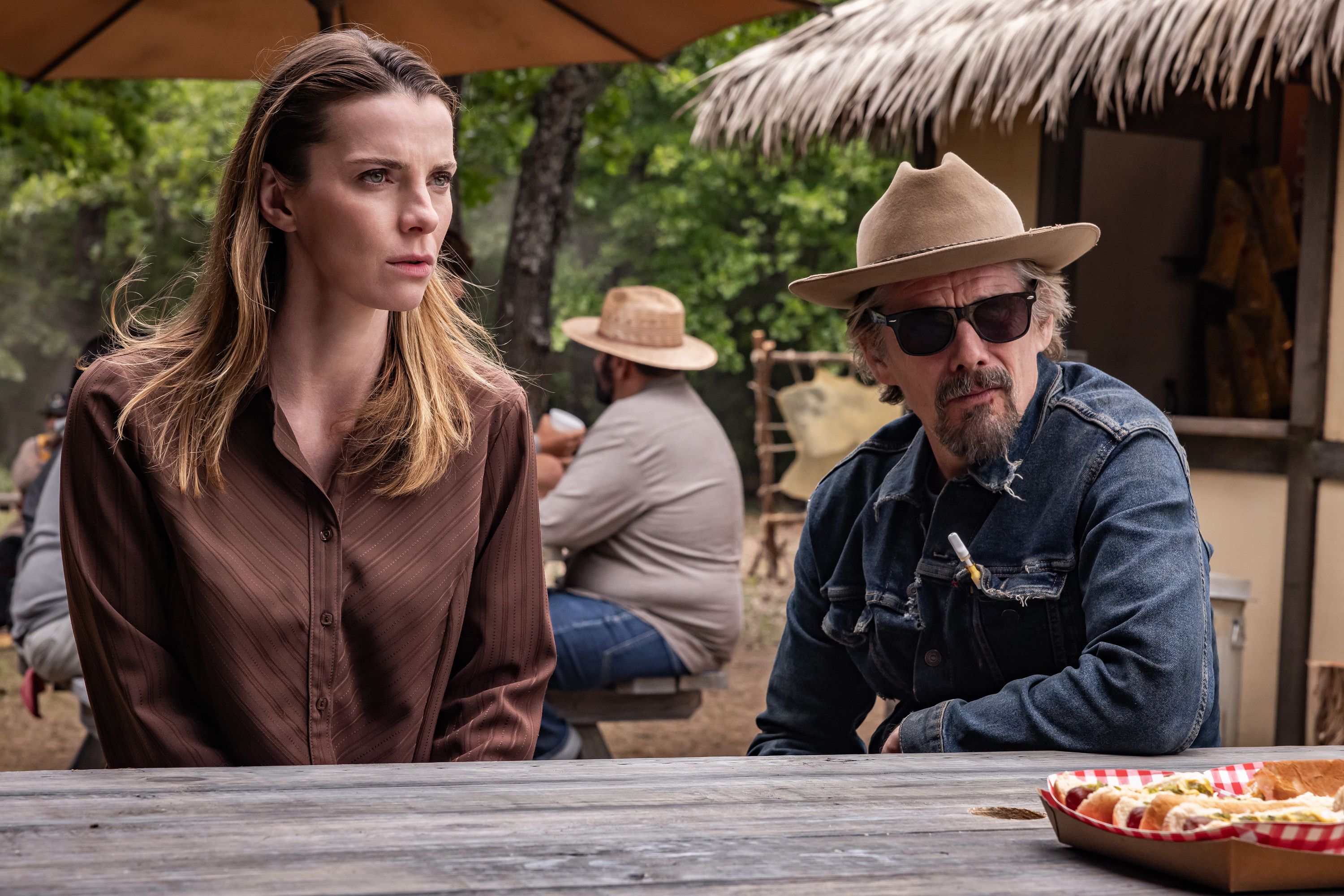
The scene captures what is so wonderful about Sterlin Harjo’s Reservation Dogs follow-up, especially in its second season, airing weekly through November 25. The Lowdown is a neo-noir that’s managing a tonal tightrope act, calling out injustice within Tulsa’s communities, politics, and law-enforcement structures all while showing you a very good time, mainly thanks to the wiles of its main character. Now, Lee is joined by Betty Gilpin’s Ginger, a stressed-out single public defender on the hunt for a former Native client who seems to have disappeared from prison, and their dynamic is impossible to look away from. As critic Kathryn VanArendonk put it in her review, “Lee is a dumbass, but at least he’s curious enough about the world to keep stumbling into something new.”
Why is this show underwatched?
Kathryn VanArendonk: Although Ethan Hawke is a star, he is not a star of the caliber where somebody would go, "Oh my God, it's a new show by famous person.” It also doesn’t have the juice of an HBO Sunday-night slot. Almost nowhere has a platform like that right now, though FX has been able to get massive attention for its shows.
I'm thinking specifically of Shogun, which did really well that first season. Comparatively, The Lowdown is an intimate, small, weirdo, niche-feeling thing. It's difficult to make the sort of sweeping “This is the new Game of Thrones” claims for this show in the way that you could for Shogun, where you also had all of these prestige-y indicators of size and bulk and violence and stuff. I also think neo-noir has never done well on television, and I say this sadly because it's one of my very favorite things. The last 20 years in television are littered with neo-noirs that critics and some audiences have loved dearly and then nobody else watched: Veronica Mars, Terriers, Teenage Bounty Hunters, Lodge 49.
Roxana Hadadi: I can't quite grasp why this show doesn’t have the buzz and juice that Reservation Dogs did. Part of me feels cynically that people think Sterlin Harjo should be making a show with an Indigenous lead, and the show should only be about Indigenous things. I can't help but feel there's this weird resistance and misunderstanding of how rooted in Indigenous social issues and history this show is, and I think there are some people who get tripped up on Ethan Hawke. Otherwise, I agree that FX’s slate right now is very IP-, very Ryan Murphy–heavy, and I think it is hard to chart a course for a genre-defying show, both seasons of which have been about the fact that American history is deeply corrupt and colors every moment of our lives.
So why should people watch it?
K.V.A.: It rules. It is maybe the most fun that I have had on TV this year. I have not picked my “best shows of the year” list, but this is in contention for my top three-ish because it is exactly the kind of thing that I love. It is intensely thoughtful and sincere and emotional while also being full of dumbasses, super funny, wry, self-deprecating, and self-aware, and it cares very deeply about the world and its characters and its audience. It’s endlessly generous; it wants its viewers to have a great time at all times. It has interesting and slightly puckish things to say about how the world works.
R.H.: It is incredibly confident and skillful to make a comedy with a rotating cast of the best character actors of the last 50 years that is simultaneously laugh-out-loud funny while also telling you that things are really bad. It is rare to have a show that does not take itself too seriously while giving you an incredibly serious analysis of the world in which we live. Lowdown allows you to laugh at Rafael Casal choking out an off-duty sheriff, and then Betty Gilpin and Ethan Hawke sniffing nitrous while they figure out how to get to the bottom of a missing man and a dead teenager.
Let's talk more about Betty Gilpin’s character. Kathryn, in your review you say the second season is stronger in part because, instead of a rotating cast of minor secondary characters, we now have Ginger. What makes their dynamic together so delightful?
K.V.A.: It’s a difficult genre to have a protagonist who you think is an idiot because by dint of making them the detective, the genre itself says you have to trust and believe and care about this person because they are going to solve the crime. The Lowdown says, yes, you care about Lee, you believe in him, and you need to know that he is making the wrong choice almost all the time — and he is the most self-absorbed and unbearably self-righteous man who has ever walked planet Earth.
All of that is in season one, but I don't think the show is able to express it as clearly and with as much humor, and so it feels a little at conflict with itself all the time. It’s a surprise in the quarter of the show when you’re like, Wait, is Lee an idiot? So it's smart in season two to have somebody like Betty Gilpin's character from the first episode be like, "I hate that I am so attracted to this piece of shit.” And she is able to hold both of those things equally throughout the entire season. It puts you as a viewer very clearly in place about the fact that the show knows that he's an idiot.
But he's so fun!
R.H.: It’s helpful to start season two with this unbearable speech in which we see all of his flaws on display — all of his self-absorption, his contempt for other people — and then to have Betty be drawn to the big things he's saying, but also know that he probably hasn't showered in five days and that if they were to sleep together, he would just never leave her alone. She’s essentially a co-lead. Lee needs a tempering presence to continuously remind us that he is doing things that are arguably unethical and not very well thought out, but there is a greater mission that is driving him. It’s a very fun dynamic.
K.V.A.: The opening speech also allows the show to have more people who are looking at him. You are seeing all of these different people react to him — other journalists, his daughter — which lets you as an audience member feel all of these different things about him.
R.H.: It's a great, incredible way to build out the different textures within Tulsa. The series' ambitions are very high about a specific type of social and historical analysis that I would argue it completely pulls off in this season.