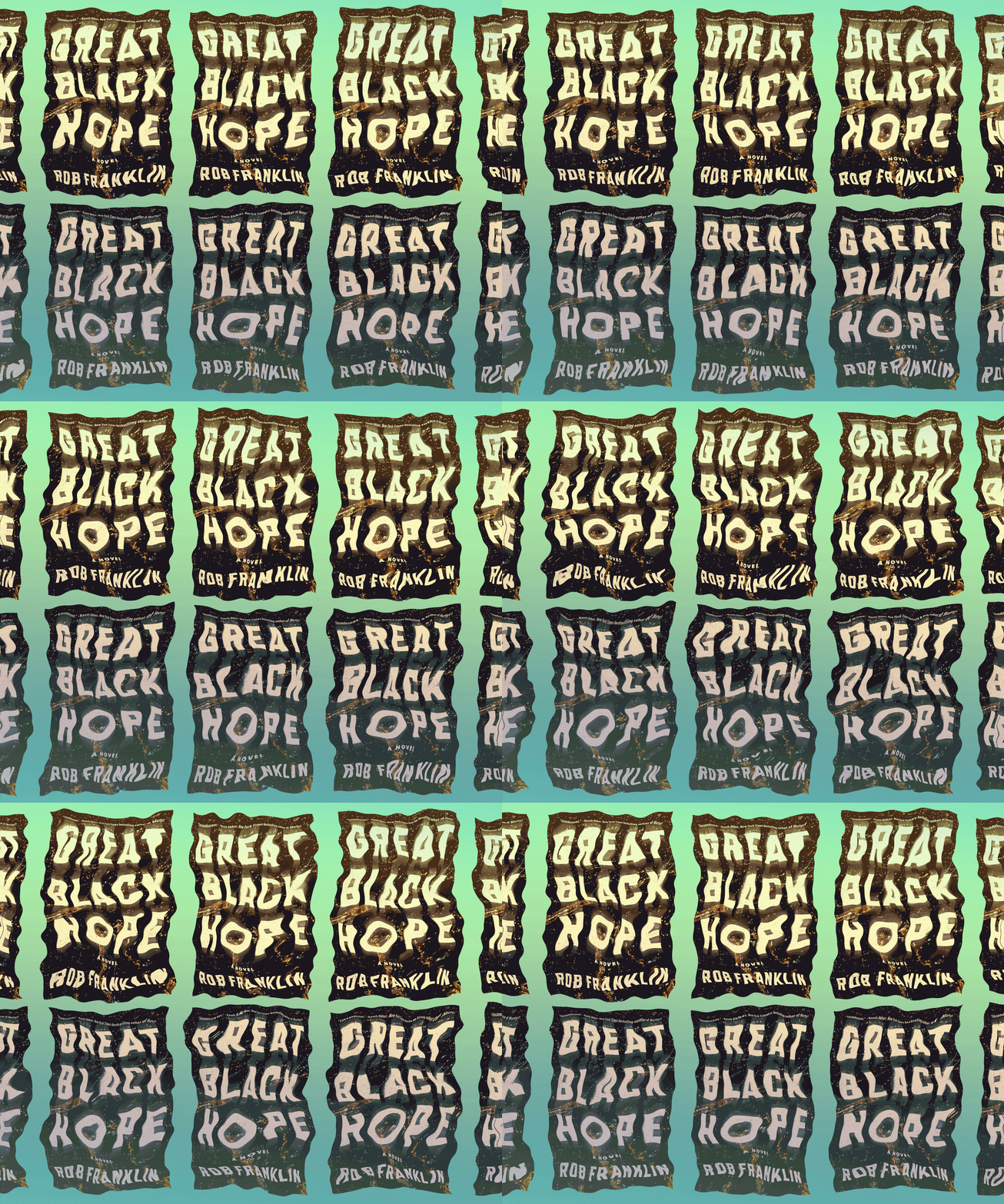
Brandon Sanchez: This was a really successful response to any issues I had with the first half. I had this highfalutin rant about time and timelessness and then I read the second half of the book and really appreciated how it treated time, history, politics. I loved Smith cataloguing this world that he grew up in, the satirical edge to everything. The way he describes crowds and different social strata is knowingly playful, even down to his descriptions of people. He’s obviously playing around when he says “macchiato-skinned,” “cortado-skinned,” “mocha-skinned.” The “Down South” section allowed him to loosen up a little bit.
Tembe Denton-Hurst: Seeing Smith in Atlanta made me like him more as a character. What sticks out in my mind is this idea of what gives you status. Once the family move out of the Whitley house, that shifts the perception of who they are. We finally get that moment where Smith is going to go pick up a suit from storage at the bottom of the house, and the woman there is looking at him skeptically until she's like, "Oh, Smith, it's you." It answered some questions about how Smith feels about the people who are beneath him. Rob Franklin as an author clearly has an understanding of that, even if we're not seeing Smith directly comment on it.
Alison Willmore: This part has that slight distance — that knowingless with which he observes everyone in the first half of the book — but with much more familiarity and intimacy. He introduces the idea of there being all these expectations put on him, especially the particular path toward success that was expected of all of these children and his parents’ and grandparents’ image of success and respectability. I kept waiting for more, though.
This is always the problem with Smith for me: I need more of his feelings. It becomes generalized out to be this “us.” I suppose part of that is deliberate: He is someone in search of what character he's going to be. But I kept waiting for a touch more of the personal in this exploration.
T.D.H.: I was waiting for an emotional reaction. I understand that Smith’s carrying the weight of this, but his parents are never outright disappointed with him. Even if he could sense that they were, it's not like it causes him this deep shame. He's just kind of vibing.
It’s just like, are the stakes real or are they not? His parents seem to be a little rigid but generally fine. We are supposed to understand that the case isn’t polite conversation, so to speak, but we don't necessarily know what that means for Smith personally. Does he really want to talk about this with other people? We don't really even see him talking about it with his sister. I don't think we ever see Smith fully relaxed. I was waiting for this certain intimacy unlock with the people he was raised with.
Allison P. Davis: There was the moment where his aunt Sonya says, “I already know what you’ve been up to, felon.” I laughed. I thought we were going to unravel something or get at how he can joke about it or not or what his sister thinks — and it just sort of stopped there.
Emma Alpern: There were many dropped narrative threads in this section. The moment when his parents are like, “You're not going back to New York yet,” and then a little while later he decides to go back and nothing happens between them. That's resolved in a weird way; it had such narrative potential to bring in something dramatic. There are moments when he almost drinks, and then he has one drink and nothing happens. That moment with Sonya was fascinating because she's such a live wire. They have one scene together, and even the fight that they have kind of dissipates.
Jason P. Frank: And he's not really involved in it, right? The book generally says that Smith wouldn't get into these confrontations. I understand that that's true, but at the same time, I need to see him in an unfamiliar situation. I need him to get involved in the conversation so that I can learn more about him and care about him at all.
E.A.: Yeah, he's observing. I guess the point is that he's — to use an obnoxious literary term — a cipher. He doesn't know what he's going to say to the proposition that he moves down to Texas to run his grandmother's properties. It got a little frustrating. Also, I felt like the historicizing was a little bit shoehorned in. There were these long chunks of text with proper nouns, and it felt a bit didactic in a way that didn't feel true to the rest of the book or maybe not even necessary. Stuff that you could pick up on from character and the way people talk to each other was instead put into the narrative in a nonfiction-y way.
There are such wonderful moments of specificity in this section. When the family goes to see the father's sermon, it feels very specific. But then there are moments when it zooms back so far and you get into something a lot more general. That didn't always work for me.
T.D.H.: As much as Franklin as an author wants to break out of respectability politics, it feels like the book is trapped within it. Smith is never allowed to make a real mistake and see a real consequence or have a really bad thought. He has to be carefully supported by the narrator because what if we don't respect him? It almost feels that the book itself is the very thing that it doesn't want to be because of our lack of access. We don't get to see Smith as human, which reflects less upon our ability to read a Black man and all of his vulnerability and insensitivity than our being locked out of it. I think it actually ends up being more isolating. Smith still feels like he's by himself, and none of us are able ever to really meet him where he's at or where he's going.
At this point in contemporary literature, we read to feel connected or entertained or scared. Even if Smith never has outright conflict, we could know all of the things he wanted to say. We've read books with deeply internal protagonists who never really quite say the thing aloud. Blue Ruin is a good example of that — things are happening externally, but that pales in comparison to all the things that are happening in the internal dialogue of the character.
I agree that the lack of interiority protecting Smith actually makes him more vulnerable to critique. I'm curious what you guys thought of this quote: “Smith could see a series of low and rundown homes rented not by students but in the sort of squalor one rolls up one's windows to avoid.” It’s fascinating that Smith is the one gazing at these communities, but then the text defaults to “one.”
T.D.H.: He said, “society at large, including you dear reader. We all drive through a neighborhood with our windows up because our families don't live there, of course.”
A.W.: The first section focuses on Smith’s privilege relative to these white characters, especially Carolyn, and these worlds where he feels acutely his role as the one queer Black man. This section gestures toward his privilege relative to characters who are coming from a less privileged background. But the book doesn’t couch this in his own observations but instead keeps turning them outward, like the conversation around the Houston apartments. Those touches would feel less self-conscious if they were more grounded in how his character was feeling. These observations are treated with a distance that makes them stilted.
A.P.D.: If, for example, he had said, “I always roll my window up when I drive down this particular street,” what would that have done differently for you guys?
T.D.H.: We would just be able to have a certain level of understanding of the character. Smith is a little bit nonspecific. I keep going back to Erasure because the character Monk was really well drawn and extremely complex. He doesn't lose his humanity by being honest about where his allegiances lie.
If a book is grappling with race and Blackness in a contemporary way, I need that awareness to be able to understand who you're writing for. Being a Black woman, I want to read about things like this. I want to read about that level of consciousness and discussions on race and class. Even if Franklin is not going to write many paragraphs about race relations in America as we know it today, having Smith exist in this space and be conscious of it or not would give me insight into how that character would experience the world as a Black man. I want to hear about the standards that he's fighting against, how he's collapsing under the weight of those standards and also upholding them, too. I want to think deeper with you, and it's not like challenging any of the assumptions I already have or evolving my understanding.
A.W.: It's not even that I need him to be like, “Ugh, that neighborhood over there,” but I would like him to be put in the space. If he mentioned that they would drive around that neighborhood to get to camp — anything that represents him as a physical person who lived and not just this abstract observation. I feel he almost floats above in this way.
I want to point to another moment when Smith is kind of doing what you were asking for. He charts a map of personal meaning onto the city as he's driving through and describes “the lamppost he'd crashed into, the Starbucks where he'd cried.” He could so easily characterize himself more by saying why he cried or make himself slightly more complicit by saying what happened with the lampost. Just tell us how that happened. We're not going to hate you for it. You can be fallible.
E.A.: The remove is kind of the point for this character. There's the one passage when he decides that he's not like a drug addict and he's almost envious of people who can give themselves that label for some reason. There's a function to this inability to put himself in these spaces, maybe.
B.S. The generation gap in the section could have been mined for more insight. One real moment of friction was the conversation with his mom about drugs. But there was also something kind of funny about it because they reached this sort of unbridgeable difference of opinion where the mom is like, “Why would you want to obliterate time? I don’t get it!” And then Smith goes back into this sort of quasi-mystical aside about time and surrendering to the night. That's a real line of division: his bourgeois upbringing, the striving, versus Smith who still even at this point just wants to do drugs and hang. There's a lot of comedy but also a lot of insight that we could have gotten from a few more set pieces like that.
J.P.F.: I mentioned last time that I've had trouble with the narration because it felt caught between the first and third person. The grandma was really helpful because I learned about someone else and how her background colored the fight she gets into with Nia.
When Smith was talking about his high-school experience, I wondered whether he was saying that those were generic queer kids and punks or whether he was missing something about them. I also felt that way generally about his interactions with Nia. I want to know what Nia thinks about him so badly. I think she looks at him with more sadness than he's indicating, but I also can't fully believe that I'm right.
T.D.H.: It's really interesting that the ball is a masquerade. As the college kids say, “What role does a mask play in Blackness?” I said, "Okay, Frantz Fanon. Okay, Black Skin, White Masks.” But there's this point where it says,