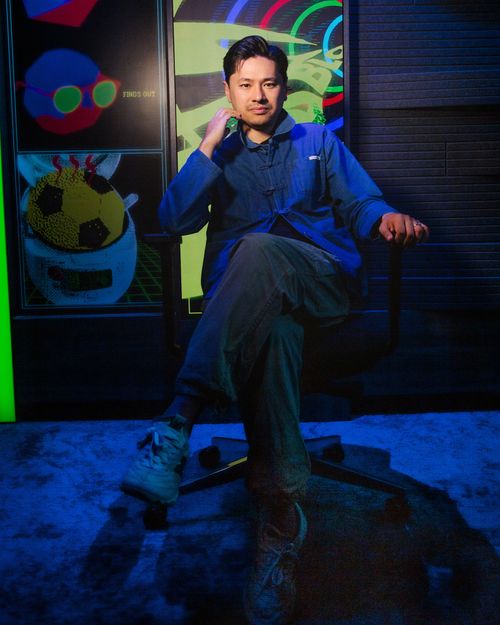
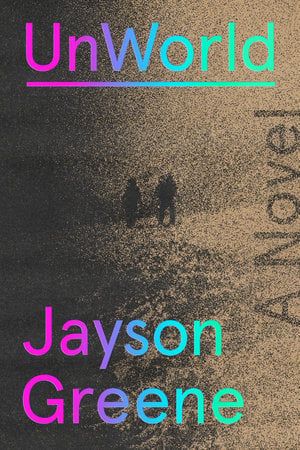
In Jayson Greene’s UnWorld, everything’s very similar to our own world, except that people depend much more on AI. Some have even gone as far as to create “uploads” — digital versions of their own consciousness that can be used to perform rote tasks. These uploads can become “untethered” from their source humans, which is what happens to Anne, a mother grieving the loss of her teenage son Alex. Her upload, Aviva, finds its way to Cathy, a professor who advocates for upload personhood. Together with Alex’s best friend Sam, Anne, Aviva and Cathy piece together the circumstances around Alex’s mysterious death. Greene answered a few questions on the phone the day before the book’s release. —Emily Gould
I was wondering where the idea of the uploads originally came from? How did you first conceptualize that?
I had an idea about this before I was a parent and before I was a bereaved parent. It was just a thought that popped into my head about ten years, 12 years ago. The idea was that a woman would be in a conflict of some kind with an upload of herself. It was just a shard of an idea, and I didn't do anything about it for many years. At the time, I was reading the work of these — at the time — very out-there transhumanist Silicon Valley people who were earnestly telling everyone who would listen to them that we were going to be uploading our minds in 2013 or so. I wanted to interview some of these people and learn what made them tick. I pitched it a bunch of times, and at the time people said, "Wow, this is a cool idea, but it's way too weird so not now. No, thank you" and I just let it go.
Then my life changed so dramatically after my daughter Greta died, after I wrote this memoir, and I'd lived through this traumatic period; this idea came swimming back to me. It was in this little period before the memoir came out, and I felt like I had a runway and I didn't know what I was going to do with my life.
People turn to sci-fi sometimes when they can't make sense of their lives. That's how I ended up writing this.
After Anna liberates Aviva, she says she hasn't cried for three months. It's almost as if Aviva, her upload, has absorbed all of her grief. If you had the opportunity to excise that from your mind via some sci-fi mechanism, that would be a difficult choice, I imagine. What do you think you would do?
That’s what Anna is to me in some ways. She's this dark wish that I've had in fleeting moments. Then, of course, it becomes a monkey's paw of a scenario. What would I lose of myself in this process if I actually could? Then what do we do with ourselves? That's what we all do. We fragment and exile little parts and pieces of our memories and lives and hide them inside of ourselves. This is just taking that and using a parable of AI for me to explain to myself what it is that I was doing in my mind as I tried to carry on with my life.
I needed a container. That container became this book. I was bailing out a boat with this dark swashy liquid with a bucket that had a hole in it. I didn't know where else to put that except inside of this story, which is appropriately very murky and nightmarish or at least dreamlike in its texture and feel.
I found it so interesting that the protagonists of this story are all women. You do a great job of inhabiting all of their very different consciousnesses, but did that decision just shape itself organically or did you play around with other people in the story having more of a voice?
I will say that the core protagonists of the novel, Anna, her upload, Aviva, and Cathy were always women, and they were always some versions of themselves, and Samantha was always a girl. At some point, in the six years that I was drafting this, I was messing around with writing in Alex's voice and writing a section from his perspective, but I scuttled that for a number of reasons. One of them was that I needed him to exist as a ball of other people's memories in this book for the premise to work.
Everyone in my life I've ever loved, who's ever been someone I identified with, has turned out to be queer in some way. I think that my thoughts have come out this way. For whatever reason, this is just how the story I wanted to tell came out. It was also a lot about stuff that feels like it takes place in the more feminine sides of our culture divide. It's about not being noticed necessarily, or yearning for acknowledgment or shrinking from acknowledgment when it feels dangerous or painful.
The part about Anna remembering the sensation of breastfeeding and surprising herself with how she experienced that magical mutuality. That resonated with my experience. I was just like, "How does he know this shit?"
My wife is a lactation consultant and has worked with literally thousands of women. I've thought maybe thought harder about some of this through talking to her and hearing her unpack her thoughts day after day and night after night for a decade. That I think directly accounts for my decision to even try to write something in that tone.
Do you think we're headed toward a future where people will actually want to create digital replicas of themselves?
We do that now. That's our lives. We are trailed by digital avatars who precede us, who go places we don't go. It is literally just like the air is charged and alive with all of our doubts and fears and lies and confessions, and it's just there. It's literally nearly palpable in the air around us all the time.
It's like we've been looking for containers forever. We just happen to have these new ones. We all use them and they're all connected, but they're spilling over with the same shit. Does that make sense?
One last question, and it's about Alex. This is a spoiler in a way, but eventually we learn from Sam's perspective and even a little bit from Aviva's perspective, that Alex's life really had become untenable in a way that was totally opaque to the people closest to him, especially to Anna, which is just so sad. How could things have gone a different way?
A lot of mental-health crises — this is getting a little headline-y, but they do happen right in front of us. They do happen in the mundane light of a Tuesday afternoon. They aren't the kind of things that always announce themselves. There's no perfect victim. There's no perfect cry for help. All of these characters, not just Alex, are crying for help in ways that are going completely unheard. Is that because everyone is so absorbed in their own needs and they're lost in their own space that they can't hear it? Is it because the person doesn't know the specific language that they might use? Children like Alex do meet very desperate ends, sadly and horribly. I wanted him to be one of those kids. I wanted it to be one of those situations, to give it a lot more weight.