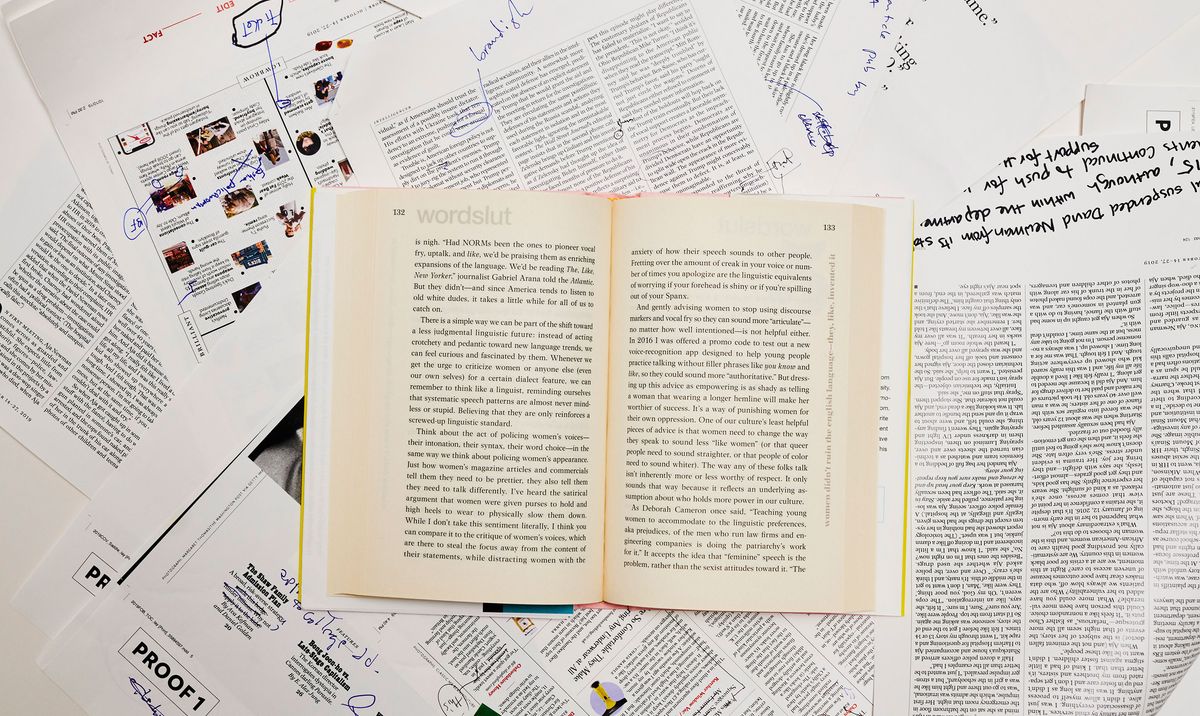
 | ![]() | | Photo: Hugo Yu | | | | Welcome back to Queries, our ongoing exploration of style and grammar hosted by me, New York copy chief Carl Rosen. This week, features editor Marisa Carroll and I speak with our senior copy editors, Camille Cauti and Emma Alpern, about one of their favorite parts of the job. |
| We publish the Daily 10x10 crossword puzzle on Vulture and a weekly NYMag puzzle. What’s it like to copyedit them?
Carl: It’s copyediting in a nutshell. We’re dealing with hyperlocalized issues of fit and word choice to make the perfect entertainment. The senior copy editor has traditionally carried the puzzle from collaboration with the creator to the final product, and I just act as the backstop. |
| Camille: Emma and I have been sharing editing duties on the New York Crossword for a couple of years now, she shepherding the web-only puzzles and I the puzzles that also appear in print. Since our puzzle-making program cannot communicate with our print-publishing software, this chasm provides me with the indelible pleasure (1-Across: Sharp, often ironic satirical language; seven letters, begins with S) of cutting and pasting each clue, one at a time, from a Google doc into our print template. (This used to be done twice for each clue, but fortunately for my carpal tunnels, we found a way around that.) Must say, though, this is the only drawback of being a puzzle editor here. |
| I have to first emphasize that puzzle constructor Matt Gaffney is terrific at his job. Certainly, I appreciate his puzzle-crafting prowess and his dedication to wordplay: |
| Clue: Person inking text for a comic book about a five-time men’s champ?
Answer: FEDERER LETTERER |
| Clue: Be the first scientist to map the minds of chirping insects?
Answer: SOLVE CICADA PSYCHOLOGY |
| |
| One of the delights of being a crossword-puzzle editor is the sheer, often bizarre randomness of the things we have to think about and the choices we have to make in any given puzzle. Some questions we and Matt have been pondering recently: |
| • What does “browned crust” actually suggest? |
| • I think this needs to be “… about a group of communist whales?” |
| • I think just [Ephemeral sandwich] is enough and makes it funnier |
| • Maybe “wingèd” with the cool backward-accent thingy? |
| • Is it offensive to clue Simple Simon and Chatty Cathy? |
| • Who is more square-jawed: George Clooney or Henry Cavill? (Ed.: We went with the latter, of course.) |
| |
| Cavill is obviously the correct choice. How else does working on the crossword demand creativity? |
| Emma: Crosswords are known for using the same words over and over. It’s just the way the grid works. The trick is to think of a novel way to reclue, say, OLE for the nth time (or NTH for the nth time, for that matter). Sometimes there’s really just one option: We’ve only got one famous ANI — DiFranco — for instance, and Leon URIS will live forever in the puzzle pages, even if he isn’t read much anymore. Luckily Matt is really good at finding clever turns of phrase for puzzle canon. [Reversible bread] for NAAN was a recent favorite, and [Refrain from farming?] for EIEIO made me laugh. A couple other winners: [Tickled Muppet] for ELMO, and [She had a Rocky relationship] for ADRIAN. |
| Our style is more flexible in the puzzle. Concessions are made. For instance, we’ve used EMOJIS as an answer a few times. Officially, our style is emoji for both the singular and plural forms. Repetition is not always bad in the puzzle! Matt has to remind me of that often. As a copy editor, I’m trained to look for echoes. A recent example: |
| Emma: 54-A/55-D: Okay that we have two Shakespeare references? |
| Matt: I kinda like that they cross. I vote keep! |
| |
| Camille: Being a crossword puzzler also requires constant vigilance for when our competitors coincidentally bring up the same subjects, especially in less culturally sensitive ways: “Of course the NY Times has DURIANS in their grid today. Clued as: [Spiky fruits with a noxious odor]. Noxious!” (This after I’d said we couldn’t call them “foul-smelling” in our clue, so we settled on “pungent.”) Expanding on the randomness, the three of us get to gauge the veracity of the clues and answers ourselves since our fact-checkers don’t get involved in the puzzle. |
| So the copy team is the last line of defense between readers and an incorrect clue? |
| Emma: Fact-checking is a big part of the process. It can lead to better clues. This week, for instance, we went from [Vegetable in a pod] to [Gumbo pod], just a hilarious combination of words. And [Small shark] became [Quick shark], not only because the shark in question (I won’t spoil the answer) can actually grow up to 13 feet, but also because “Quick shark,” in Matt’s words, “sounds cool.” A while back, we went for [Driver in “Ferrari”] to [Driver in “Paterson”] — Ferrari wasn’t set to come out for many months, and though that clue involved a nice misdirect, we couldn’t justify using it. But luckily, Adam Driver’s character in Paterson is a bus driver: not quite a redirect but a wink. |
| Carl: I have to chime in about the macro issues. I solve the puzzle after everyone is good with it and make final suggestions about the wording of clues. I also check the transmitted pages to make sure the grid has survived the production process intact. A date when it didn’t — June 12, 2017 — stands as a perpetual day of remembrance for me. Owing to a printer’s error, the wrong grid appeared in the magazine, and on that day, the letters, emails, and voice messages began to flood in. We have a better production process now, so that shouldn’t happen again, but we can never let down our guard. In a weird way, I was delighted by the volume of reader responses. The only commentary I had previously received about the puzzle came when my next-door neighbor threw her copy of the November 1, 2004, issue of the magazine against my apartment’s door in frustration. I realized quickly that she thought we had dispensed with the puzzle, as that was the date the first “Approval Matrix” ran on the back page — the traditional spot for the puzzle. She didn’t even flip through the rest of the magazine to find it! The back page had been her habit for decades. After she died and her place was opened up for an estate sale, I saw hundreds of New York Magazines scattered around her three-bedroom apartment, all with the puzzle filled in. (I found a copy of our third issue from 1968 sitting by the bathtub. I promptly bought it from the auctioneer.) It goes to show that the puzzle thrives on regularity and a drive toward perfection and is best regarded when the reader can silently depend upon it. |
| Here are some more tweaks that came through fact-checking: |
| Emma: [Licorice flavoring ANISE]
Licorice is traditionally flavored with licorice root. I think anise is used in some American varieties, blasphemously. Could do: [Licoricelike flavor] or [Seed used in biscotti]
Matt: [Seed used in biscotti] is nice, did not know that. |
| |
| Emma: [Left unplowed, as a field FALLOW]
Actually, fallow fields are plowed! Who knew? How about: [Left unsown, as a field] |
| Matt: I certainly did not. Your clue is nice. |
| |
| Matt: [Put back in the pot, as a potato REBOIL]
Trying to imagine how one would “reboil” a potato. Maybe [Reboil, as a stew] since Italian ribollita has that literal meaning.
Emma: I like that better! |
| |
| Matt: [“M*A*S*H* Emmy nominee FARR]
Nope! Just about the only main actor to *not* get an Emmy nomination. [“M*A*S*H” actor] (everyone will put ALDA in, then wonder if it’s SWIT, then ohhhh …)
Emma: Good catch! |
| |
| Camille: This process is actually more fun than it sounds. A smattering from our recent emails: |
| • Doesn’t look like tetherball is primarily a “solo” exercise |
| • We should specify “women” (FEMINAE) in the clue since “girls” would indicate PUELLAE. |
| • Turns out all bogs are peaty so just [Like bogs] |
| • “Leaves” seems to be by far the preferred term here for aloe, not “fronds.” Out-Googles by 200 to 1. |
| • Does this suggest DNA is made of genes? Isn’t it the other way around? |
| • Apparently they do have pitchers in T-ball, but they only play defense. (T-ball, always a thorny subject.) |
| |
| Often, a multiplicity of meanings generates confusion even for the editors, as in the dialogue around this brief clue and answer: |
| 29-Across: Makes it TAG. “This is in regard to baseball, yes? As in tagging first base safely? (Or is it a graffiti thing? As in the tag is the tagger’s signature?),” which Matt of course answered with “As in the playground game Tag, where you make someone ‘it’ by tagging them.” |
| |
| I hear that no one is more frightening than a crossword obsessive scorned. |
| Emma: Puzzle world is its own place. I’ve always heard that puzzle solvers can be prickly, so we check everything really carefully. For instance, Camille’s comment from a few weeks ago about our clue for ETHOS: “Ethos maybe isn’t quite about the spirit of the times (that’s more Zeitgeist) — it’s more a set of beliefs held by an organization/person. Thoughts on changing? Perhaps just [Guiding beliefs].” We probably wouldn’t have gotten angry emails about it, but better safe than sorry. (For what it’s worth, I’ve had only positive experiences with New York Mag’s loyal solvers since I started editing the crossword with Camille in 2021.) |
| Subscribers submitted more than 100 questions and pet peeves. Here, Carl responds to a few of them. |
| Lately I’ve noticed an escalation in what I consider annoying tendencies in writing. For example, since when has “irregardless” become a bona fide word? Or “concerning,” a brutalization of “worrisome” and “disconcerting”? Or “myriad of,” appearing more and more in published work? Please help me gain some understanding of how and why we’ve allowed the bastardization of the English language to reach this point. I can’t tell you how many vaunted publications have used “myriad of” and “concerning,” much to my disappointment. —Jocelyn |
| This is hardly an issue of parentage, and you’re mixing complaints: Irregardless is not a word, so let’s drop that entirely. As for the parentage of the other terms? Concerning, while annoying to read because it has become a euphemism for “Shit’s gone sideways,” is a legitimate relative of disconcerting, at least as far as Merriam-Webster’s is … concerned. Re: “myriad of”: You’ve drunk the Kool-Aid! The noun form is the classical style — it was Faulkner who (at the time incorrectly) used myriad as an adjective in Go Down, Moses and still won the Nobel Prize. I’ve come to believe, as he did, that the past is “not even past,” so there is no point for us “to reach.” |
| I’m a lawyer and much of my job is editing other lawyers’ writing. I can’t quite pinpoint exactly when it happened (I’ve been a member of the bar for 25 years), but somewhere along the line, lawyers have decided that the phrase “as such” means “therefore” or “as a result.” It drives me completely bonkers. At least five times a week, I see sentences like “The plaintiff failed to show that the landlord knew about the water in the lobby. As such, this Court should dismiss the action.” It makes no sense. “Such” needs an antecedent, right? I mean, there’s obviously a right way to use “as such,” as in, “Dave was president of the men’s club. As such, he was empowered to make the final decisions on the venue for the party.” But no one uses it that way anymore. It’s always “X happened. As such [that is, therefore], we should do Y.” Am I off base, or does this usage need to be stamped out? —Laura |
| For reasons unknown to myself, I decided back in the day to study the Chicago Manual of Style rather than go to law school, so I can hardly tell you why lawyers do what they do. I suppose that since the bar is self-regulating, it can make any stylistic judgment it likes. And you can’t say that you don’t know what the other lawyers are talking about; far be it from me to prohibit a usage that makes the case clear. At least “As such” is much shorter than “This being the case” — think of all the keystrokes it saves you! |
| What happened to among? Seems as if we only use between these days, even when several [plural noun] are involved. I missed the memo. What did it say? —Kate |
| You missed our magazine. We make this distinction. |
| Every week, we’re sharing a question from our copy quiz and will include the answer in the next newsletter. |
| Instructions: Make corrections to the sentence below. Mark it up as you please. Feel free to rewrite or add queries. Change as much or as little of it as you see fit. (It’s not a trick — some things are dreadfully wrong with it.) The point is to show what you can do. |
| More importantly, he lost his job due to corporate restructuring and his voice due to screaming his vocal chords out. |
| Last week’s question: Having left the governor’s mansion, you don’t hear much of ex-governor Elliott Spitzer and his wife Silda anymore. They have moved out of the spotlight. |
| Who are you? I think when I read this. The you who hears not isn’t the subject — that would be the former First Couple of New York State, to whom the first clause, a classic dangling modifier, likely refers. Getting the Spitzers involved in the action, though, is easier said than done. Is the “hear[ing] … anymore” any more important than the having left the Governor’s Mansion (caps added per style)? A zest for engaging this issue will show me that the copy editor means business. A green candidate might be content to flip things around, add commas on either side of the singular spouse’s name, and trim a couple of letters off the Luv Guv’s name (always double-check names with double letters; a bad show of identifying a public figure will undercut our authority. That the provenance of a particular name may highlight a great irony should serve only as a mnemonic for its proper spelling). To stop there, however, ignores the original problem: The second sentence confirms our suspicions about the true subject, but it seems to exist merely to wax poetical on the same. So bypass the “overheard from an Uber driver who read about it in the Daily News” kind of sourcing that the cliché summation suggests and boil the whole thing down to “The Spitzers are gone.” |
| Reminder: Next week is the final edition of this round of Queries! Be sure to send us any remaining questions, pet peeves, feedback, or requests at queries@nymag.com |
| | | — Carl Rosen, New York Magazine |
| | |