| A Subscriber-Only Newsletter |
|
| |
|
Illustration: New York Magazine |
Hello, and welcome back to Queries (this is the eighth edition!). If you’re new here, I’m Carl Rosen, New York’s copy chief, and for the next five weeks I’ll be talking with features editor Jacob Rosenberg about all things words, grammar, and style. This issue, we discuss “Words We Don’t Say,” Walter Benjamin’s Wiederholung, and the “shadow ban.”
Jacob Rosenberg: New York Magazine has a long-running, ever-evolving document of words that should not be used. So let’s start there: Why do words get banned?
Carl Rosen: Words are banned when they lose their usefulness to a writer, when they lose their power. We add to the ban as hackneyed expressions crop up, and we’re Slacking all the time with editors and writers about candidates for inclusion. The final decision rests with our top editors, who originally created the list, but we thrive on discourse. Recent subjects under discussion include “overstatement of process” (“in preparation for this story” is not a tale you want to tell — get to the point!), “cascading cliché avoidance” (when busted clichés are used to replace ones wearing thin — a suspicious number of “Rorschach tests” started showing up after we outlawed “shape-shifter”). The impetus is pure William Zinsser: As he put it, editors and writers are the “custodians of memory” with a duty to one another. But there’s a lot you can do yourself: Reread what you’ve written, then reread again with an eye to what can be cut. As a newcomer, I was taught to put my pencil point over a word to see if it was necessary to the sentence. If not, the same pencil would scratch it out. It’s even easier now to trim the fat — you can search for superfluous phrases among the eight categories we use in our doc.
These are self-explanatory, and none is sinister or political: We watch out for (1) journalese (e.g., donned, sported, garnered — no one talks this way IRL), (2) publicistspeak (cutting edge is anathema, as is hype; also avoid textworms), (3) ambiguous words (nondescript — our advice is to describe it!), (4) clichés (weighty tome, not his first rodeo), (5) overused trendy terms (unhinged, the math isn’t mathing, and the worst example ever: shizzle), (6) overly casual language (anyway, what I mean is …, if you were wondering …), (7) junky writing (needless to say, not to mention, the aforementioned — too legalistic, use your own words!), and (8) just the wrong word (including when you mean featuring, two-year anniversary when you mean second anniversary, effect when you mean affect and vice versa). The last category hints at our house style guide, a separate doc maintained by the Copy Department. Unlike that guide, which is just for copy editors, the forbidden-words doc is figuratively a companywide index — everyone can see it and see what loses by rising on the chart. It’s a great way to get people on the same page (as it were), especially when novelty language loses its luster. And remember that the standards that work for the professionals are no different from what works for you, Dear Reader.
|
|
|
|
A relic of the 20th century. |
How did the list come about?
The current list came into play at the tail end of COVID, when the transmission of doctrine was delimited by the computer wall. Because many of us had to work from home, and some of us still do, it became harder to teach the tricks of the trade. The top editors were sensitive to the decrease in opportunities for newcomers to learn by osmosis; they saw the job was becoming abstract, and many writers, living online, were falling prey stylistically to the influence of the TikTok-racy or Twitter-talk (this was before it became X — please don’t get me started on people who miss a brand name). So they got this idea: We need to teach writing again. This led to the Night School newsletter series; to in-house, off-the-record Magazine Club seminars hosted by veteran investigative reporter Andrew Rice; to (dare I say) the word-nerdery of Queries; and to our up-to-date, Journalism 101–intensive “banned”-words document (I use quotation marks not to scare but to hint at a built-in plasticity).
The last solution, the doc with the forbidding title “New York Magazine’s List of Forbidden Words,” begins with a query betraying a gleam in the gimlet eye of they who have forbad: “What does New York sound like?” You’re invited to answer. So it’s less rule by fiat and more a resource, a conversation starter. Begun in 2022, the list, which underwent extensive vetting by our editors and incorporated many a Copy Department credo, is not Holy Writ but a call for sensible standards.
What was it like before there was an official list?
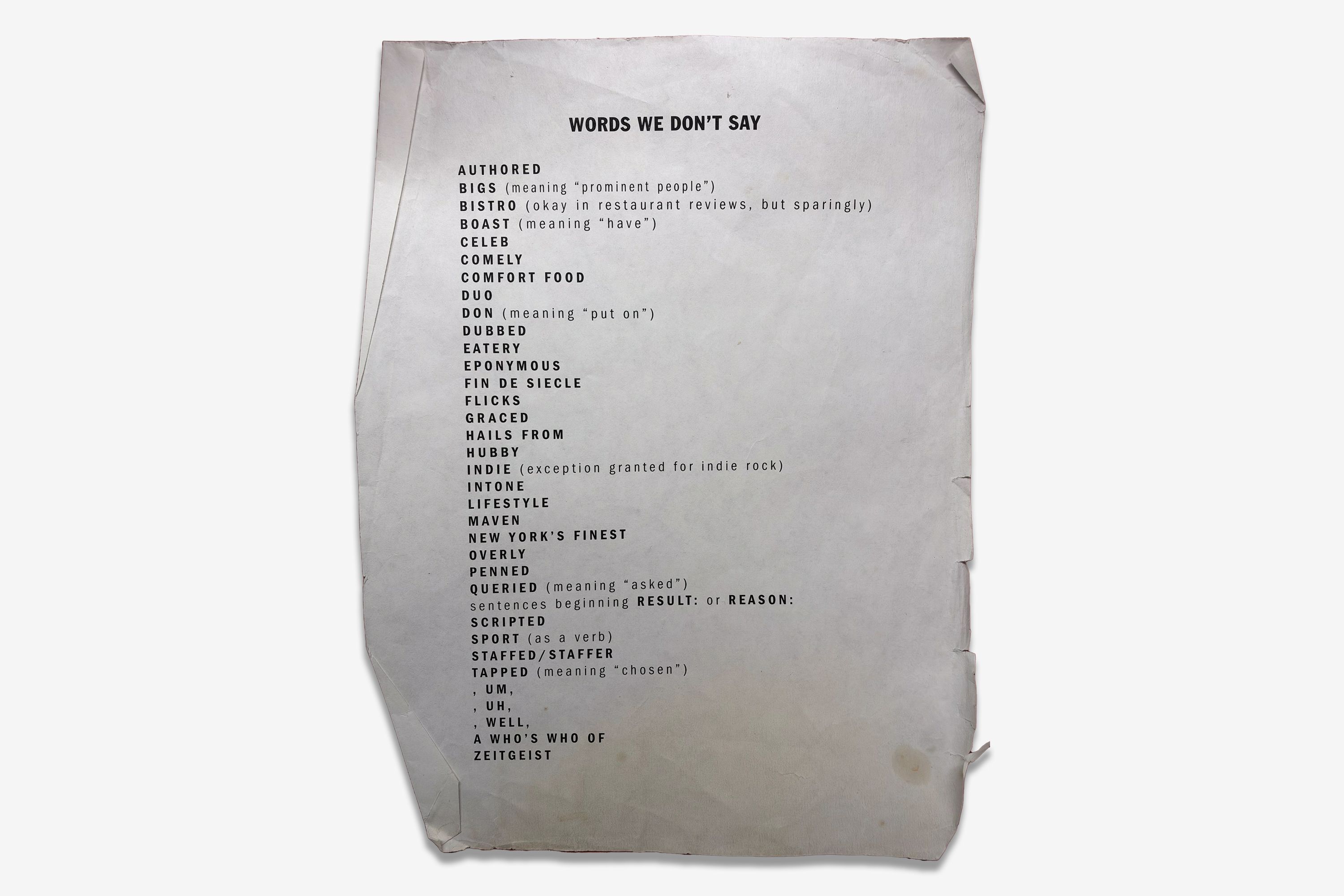
There was always a kind of list; it just used to be shorter. When I joined the magazine in 2000, I was presented with a worn, pressboard-covered printout of the house style guide, which included the single-page “Words We Don’t Say,” a relic of the ’80s with a few ’90s editor-in-chief additions — some Ed Kosner’s, some Kurt Andersen’s — and a history of intermittent enforcement. Some of the terms on it are no longer banned or even noticed much, such as lifestyle; back then, it was indicative of cryptofascist-cult groupthink. One of my new colleagues at the time claimed that expressions on the list were not strictly verboten, just considered gauche. Soon after, a (possibly purloined) copy of The New Yorker’s (rather retrograde) style guide was passed around, uh, the industry; I thought, At long last, the inner workings of the magazine world revealed. Alright! Then, on close reading, “someone” noticed that most terms matched our own (minus the diaereses) and that the dos overwhelmed the don’ts: Just three entries terminated in an express ban — alright, more importantly, and transpire. (These in addition to the admonition “Do not write ‘at long last’ unless for deliberately obnoxious effect.”) Okay, I was schooled.
The takeaway was that banning is secondary to burnishing. For a couple of years — yes, some dramatic years — I put my head down and studied the positive recommendations of our style guide (many initialed by contributors from days of yore) and added some of my own, even as ownership changed twice and media moreso. When the dust settled (still too literal an image from that time), a refreshing attention to visual detail returned to the magazine, including what I consider more a “best practice” than a ban. Rather than write it down, an authority whispered it to me in 2004, though the “shadow ban” was empowering nonetheless: There would be no more curse words in display (headlines, pull quotes, captions, etc.). This was a timely change, as the “cool” of cussing in print had died along with jeans of Yosemite circumference. There had long been an obliterating style at The New Yorker for “proscribed words” (“- - - - you”), and Newsweek (in its 300-page guide circa Y2K) barred all “barnyard epithets.” We were called on merely to remove such terms in giant type (body copy was specifically spared in order to preserve voice).
The spur to change was a pull quote marked by tmesis, or “expletive infixation” — un-fuckin’-believable, right? As the recently installed copy chief, I didn’t mind the directive as it had no effect on the reporting. And I had learned that display functions as a marketing tool — it’s used to draw in, not repel, readers. Profanity in 48-point Egyptienne Banner can stall out an article. With a ginormous @#$% dominating the screen or page, some might scroll away; others might stay but have their “content experience” colored blue, regardless of authorial intent. I continue to find the prohibition affords readers the opportunity to hear us out.
How do you use the “Forbidden” list?
In the warnings against “journalese,” the first bit of advice is to eschew penned for wrote, and I must report that I, serene in the gossamer of documentary recommendation, recently did just that, swapping it out in an article in the current issue. As for the overused terms, for a while, we were all okay with calling an important principle or desideratum a “North Star.” Then it went south: The distinctiveness of the expression was leached out from overuse. Rather than find guidance in the yellow supergiant Polaris, we got the equivalent of the North Star of athleisure, the North Star of Peak TV, and so forth. Bubbling under right now is tack, which I see zigzagging all over the place. It’s not a banned term, and I am relieved it has replaced the malapropism tact, which used to show up when someone couldn’t decide between tack and tactic. Overdependence on a term, however, is anathema, so Copy is keeping an eye on its usage — tack showed up three times this issue. Also of concern is an inexplicably in-vogue term I associate with Aubrey Beardsley or 1930s French funny papers: fantasyland. It popped up twice this issue: first in a quotation (“It’s a fantasyland inside”) in “Design Hunting,” by the inimitable Wendy Goodman, then in a descriptive passage in our report on “iPad Parents” (“For a generation that often struggled to contextualize much of what it saw online, AI created a hyperpersonalized fantasyland”).
|
A “soft ban” applies to terms that might be overused. |
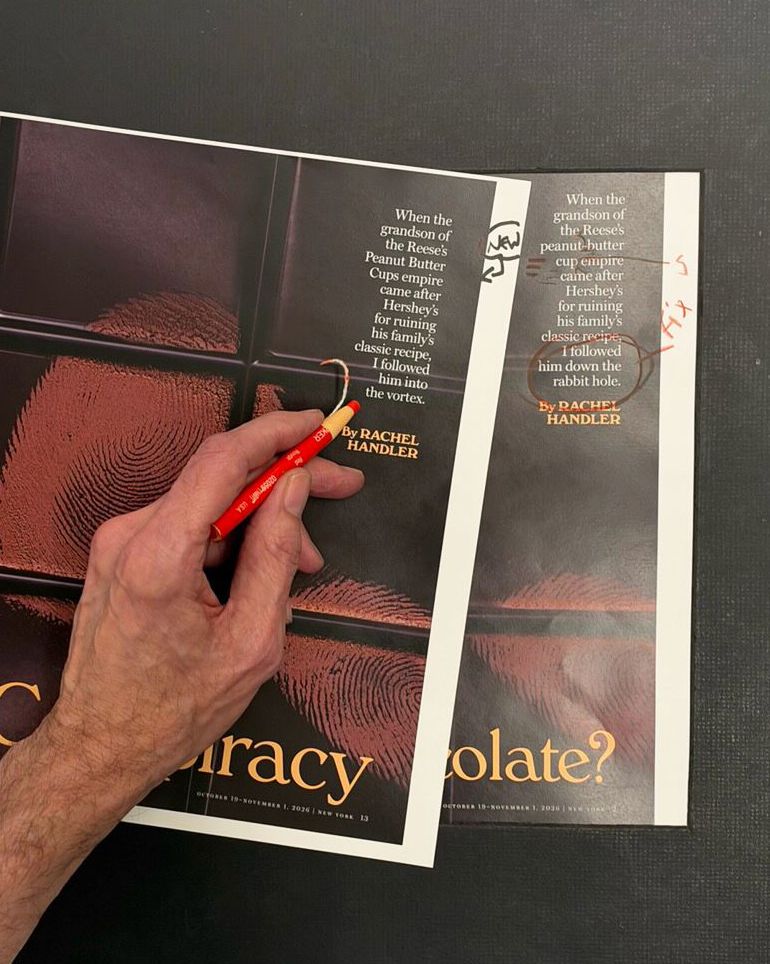
I was tipped to this trend when I read the phrase “shitposter’s fantasy” in the roiling vortex that is our cover story on Hershey Co.’s faux-coa (pronounced Foe Co.; a brown confection sans cocoa butter), by Rachel Handler. Once I saw that, the two fantasylands came to mind and I scrambled to make sure the term was not used to describe Hersheypark (though it would have been apropos). Fortunately, we did not sin trebly. And I am happy to report that, in the same feature, senior copy editor Emma Alpern took action against the quasi-banned term rabbit hole in the display, likely arguing the narrative was more about dropping into a vast, Wonka-style Mixmaster of cocoa-butter-less cocoa akin to the swirling abyss at the conclusion of The Narrative of Arthur Gordon Pym of Nantucket, by E. A. Poe, than a bunny’s lair. Permission was given to use vortex, which itself is sure to rise on the chart of opprobrium once it bears repeating à la Walter Benjamin’s Wiederholung (can you imagine a more localized work of art, with as great an aura, than Rachel’s revolutionary reproduction of bean to bolsheviki?). Copy kept the display as fresh as the prose, and social media successfully ran with the word. In a small hour, though, I had to ask myself, Was the writer thinking of Alice in Wonderland all along?
|
|
|
|
Do You Think Like a Copy Editor? |
Every week, we’ll share a challenge for prospective copy editors. Send your answers to queries@nymag.com or leave a comment in our discussion hub and we’ll go over the question in next week’s newsletter.
|
|
|
|
Instructions: Make corrections to the passage below. Mark it up as you please. Feel free to rewrite or add queries. Change as much or as little of it as you see fit. (It’s not a trick — some things are dreadfully wrong with it.) The point is to show what you can do.
Most importantly, whom he says would blame you were you to pack it in with the lemon aid and unsqueeze its juice, and boil off the sugarcane, finding summersweet solace from the power of positive thinking at, alas, alack. |
We’ll be back next Wednesday. Keep sharing your questions at queries@nymag.com. And don’t forget to get your Queries merch! Subscribers get 20% off with the code QUERIES20.
— Carl Rosen, New York Magazine |
|
|
|
|